About Us
About Us: we build cultivation games, and we review themHere is the ruler we use, and the scores it produces.
No vision statement here. Three things: what we have built, what we have played, and why anyone should accept our score on someone else's game. The last one matters most, so the rubric and the deductions are laid out in full.
01Who we are
cultivationgame.com is ours. We make cultivation games, we review cultivation games, we write guides and keep a catalogue.
This genre is hard to build in. It asks for numbers sense, storytelling, and a way to make "thirty years in seclusion" legible on a screen. We have shipped two attempts — one just released a demo, one is still in development. Which is why we rarely tell other studios "how hard could it be."
02What we have in hand
Code: Qingfeng (《代号清风》)
An interactive spy-thriller AVG set in Shanghai, 1947. Three heroine routes, six full endings plus a true ending, five hours for the main line and twelve for every branch. The demo went live in May 2026; the base game has not shipped. The Steam page currently reads "no user reviews." That is simply true, and we are not going to fill the gap with the word "highly anticipated."
One more thing, stated up front rather than dug up later: the store page discloses AI assistance for story art and music.
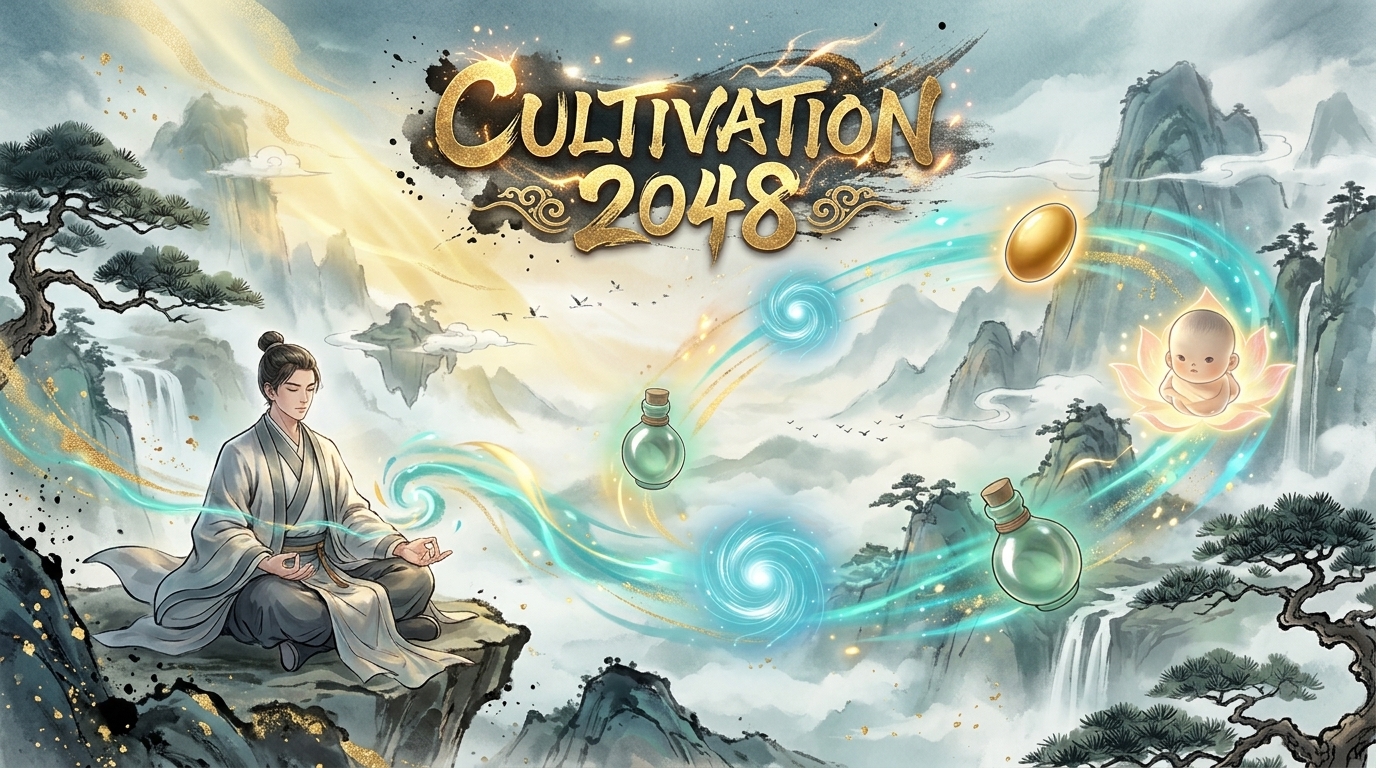
Cultivation 2048
In development. It puts realm breakthroughs onto a 2048 board: gather enough qi to attempt one, the attempt can fail, failure knocks your top tile down a grade. That sounds simple and is not, because "should I gamble now" has to be a real hesitation every single time.
It is nowhere near ready to be reviewed. So this site gives it no score, and no "coming soon to redefine the genre."
03What we have played
Between us we have tried most of the names in this genre. Some start to finish, some for a dozen hours before we put them down. Here are ten, in plain language, strengths and faults both. Disagreement is fine; each point is tied to a mechanic, not a mood.
Built as management sims
Amazing Cultivation Simulator
Sect management plus individual cultivation. The five elements, qi, techniques and feng shui genuinely interlock — the most rewarding numbers in the genre to take apart. Dozens of hours in, you are still finding combinations.
The other side is brutal: it does not teach you. There is effectively no tutorial, and your first five hours will be spent with a wiki open in another window. That is not difficulty, that is missing onboarding.
The Scroll of Taiwu
It began in early access in 2018 and has been rebuilt more than once since. It was the first game that made a jianghu feel describable by algorithm. NPCs age, hold grudges, spread your reputation, and settle scores while you are elsewhere. The systems are absurdly deep.
The price is interface and guidance. More people quit in the first two or three hours than finish. It remains the archetype of "I know it is good and I cannot get in."
Built as open worlds
Tale of Immortal
It sells a fantasy: I want to be a wandering immortal. Random encounters, fate-defying choices, realm suppression over strangers — the freedom is real, and the first twenty hours are compulsive.
The mid-game is where it thins out: grind, repetition, a story that cannot carry the length. We checked the store page: 180,863 Simplified Chinese reviews, 56% positive, rated "Mixed" [1]. That is not a handful of detractors. A substantial share of players found the back half empty.
Built as action games
Warm Snow
2022. Flying swords, schools, build crafting. It plays well, a first run is solid, and the combat feel is good for the price.
The story is scaffolding. Come for narrative and you will be disappointed; come to cut things and you will be satisfied.
Eastern Exorcist
Side-scrolling action with art that carries the screen. Timing is tight and forgiveness is low; it takes a few deaths to find the rhythm. Small enough to finish over a weekend.
Built as stories
Legend of Mortal (活侠传)
2024. The character writing is better than most Chinese RPGs manage. It is willing to make the player uncomfortable, to keep its protagonist ugly and unwelcome. That is rare.
The systems are rough and the game is divisive. Some read it as the bravest script in years; others read it as being punished by the script. Both readings have evidence.
Wandering Sword (逸剑风云决)
Pixel wuxia with a great deal of story and traditional turn-based combat. For readers, not for reflex players. Go in wanting action and you will fall asleep.
Gujian 3
A 2018 attempt at Chinese AAA. At the time the visuals and combat were a benchmark, and the action still holds up; production values are high throughout.
The pacing is slow and the opening chapters drag. Its problem was never quality. It was timing.
Hybrids
Da Xia Li Zhi Zhuan (大侠立志传)
An open jianghu with a lot to do, and the early hours are genuinely addictive. Content density drops off a cliff later; it starts to feel like clearing a to-do list.
Mi Chang Sheng (觅长生)
Long-horizon cultivation, the most authentic genre feel in the batch, and the slowest. Built for idling and tending. Not for anyone who needs a climax within two hours.
The list is incomplete. There is more on PC and much more on mobile, but mobile is where the genre homogenises hardest, so we catalogue sparingly. Fewer entries, better entries.
04One ruler for all of them
Cultivation games resist scoring because they are number games, narrative games and simulation games at once, in different proportions per title. A single flat checklist ends up measuring Amazing Cultivation Simulator and a branching visual novel with the same ruler, then producing an average nobody believes.
So: seven fixed dimensions, weights that shift slightly by sub-genre, judging criteria that never shift.
| Dimension | Weight | What it looks at |
|---|---|---|
| Coherence of the cultivation system | 20% | Are realms structured; can breakthroughs be anticipated; do qi, lifespan, materials and success rates actually interlock |
| Depth and strategic space | 20% | Are there decisions worth optimising; do builds truly diverge; can one situation be solved two ways |
| Narrative and worldbuilding | 15% | Is the world carried by mechanics or only by text; do branches have consequences |
| Pacing and sense of cultivation | 15% | Onboarding in the first two hours; real mid-game milestones; whether the endgame becomes stat-stacking; whether a breakthrough costs something |
| Polish and stability | 10% | Saves, UI density, key rebinding, performance, patch cadence, blast radius of known bugs |
| Localisation and accessibility | 10% | Language coverage; consistency of realm terms across Chinese and English; text size, contrast, subtitles |
| Content volume and replay value | 10% | Total hours; reasons to restart; whether the game is still being updated |
Ten games, scored (base weights, November 2026)
| Game | System | Depth | Story | Pacing | Polish | L10n | Volume | Total |
|---|---|---|---|---|---|---|---|---|
| Amazing Cultivation Simulator | 9.0 | 9.0 | 6.0 | 5.0 | 7.0 | 7.0 | 9.0 | 7.6 |
| The Scroll of Taiwu | 8.5 | 9.0 | 7.0 | 4.5 | 6.5 | 6.5 | 9.0 | 7.4 |
| Gujian 3 | 6.0 | 6.5 | 8.0 | 6.0 | 8.5 | 7.5 | 7.5 | 6.9 |
| Warm Snow | 6.0 | 7.5 | 5.0 | 8.0 | 8.0 | 8.0 | 6.5 | 6.9 |
| Da Xia Li Zhi Zhuan | 6.0 | 7.5 | 6.5 | 6.5 | 7.0 | 7.0 | 7.0 | 6.8 |
| Wandering Sword | 6.5 | 6.0 | 7.5 | 6.0 | 7.5 | 7.0 | 7.5 | 6.7 |
| Tale of Immortal | 7.0 | 7.5 | 4.5 | 5.5 | 6.0 | 7.0 | 8.0 | 6.5 |
| Legend of Mortal | 5.5 | 6.0 | 9.0 | 5.0 | 5.0 | 7.0 | 6.5 | 6.3 |
| Mi Chang Sheng | 7.0 | 6.5 | 6.5 | 4.0 | 6.0 | 6.5 | 6.0 | 6.1 |
| Eastern Exorcist | 5.5 | 6.5 | 5.5 | 7.0 | 7.5 | 5.5 | 5.0 | 6.1 |
How to read this
One misunderstanding to clear up: a low score does not mean a bad time. The rubric measures how completely a cultivation system is built, not whether you will enjoy yourself. Those two things come apart constantly.
Tale of Immortal is the standing example. It sells the most and lands mid-table at 6.5, let down by story and pacing. But the freedom it offers, and the pleasure of a random encounter going somewhere strange, is not something this table can capture. Want to be a wandering immortal? 6.5 will still carry you for a long time, though you will have to invent your own reasons to keep going.
At the other end, Amazing Cultivation Simulator tops the list at 7.6, and earns it — provided you can survive five hours with no guidance. The score is our judgement. Whether it suits you is a separate question.
The range is narrow too, 6.1 to 7.6, all bunched together. That is the honest picture. By this rubric, nothing in the genre clears 8.0 today, because nothing has all seven dimensions in place. Anyone calling a game the perfect cultivation experience probably has not played enough of them.
05How the score is calculated
- Each dimension is scored 1–10, in half-point steps.
- A dimension score describes that dimension only, never a recommendation. A 4.5 in narrative stays 4.5; we do not round it up to make the total look better.
- Total = Σ (dimension score × weight), one decimal place.
- One hard rule applies afterwards: any dimension below 5 caps the total at 8.0, and the verdict must name that dimension. This exists so an average cannot hide a structural fault. Nothing has actually hit the ceiling yet, because nothing has reached 8.0 in the first place. The rule is there for the day something does.
- Reviews are re-run after major updates. Old scores and their dates stay on the record.
Four rules
- We do not score our own games. Ours are judged by other people. This site does not rate them and does not badge them "editor's pick."
- A score must reproduce. Every review states version, platform, hours played, completion. Play under the same conditions and you should land close. If you put thirty hours in and think the narrative is a 7, then it is a 7 and we got it wrong.
- Only data you can click. Steam review counts, store language tables, official patch notes: citable. Publisher claims and uncredited sales figures: no.
- Conflicts go at the top. Commercial partnerships, review keys, joint promotions: one line. When there is none, we say that too.
06When we refuse to score
- Unreleased, trailer only: no score. A "pre-release watch" note, clearly labelled.
- Reskins: we name the evidence — reused art, near-identical system structure — and mark down volume and replay value. The judgement has to point at something you can check.
- Forced ads, manipulative monetisation, features that contradict the pitch: filed as not recommended, with the specific behaviour described. "It felt scammy" is not an argument.
What we are not good at
- We are small. We cannot chase everything on sale, and entries lag.
- Some console releases can only be assessed from public material and player reports. Those entries are labelled "not tested in-house." We do not pretend otherwise.
- No institutional accreditation, and no claim to authority. Credibility gets earned twice: scores that reproduce, sources that open.
- Scoring is subjective. Someone at hour three and someone at hour eighty will rate pacing two points apart. That is why every review carries hours played, so you can adjust for it.
07Contact
Suggestions and corrections: the contact page, with title, platform and the specific problem. If a sentence here does not match reality, say so. Fixing an error matters more than protecting a reputation.
Code: Qingfeng on Steam: app/4599380; demo: app/257319204.
08Sources
- [1] Tale of Immortal Steam store page: 180,863 Simplified Chinese reviews, 56% positive, rated "Mixed." Checked 18 November 2026. store.steampowered.com/app/1468810
- Release dates, developers and language support taken from each title's Steam store page, checked 18 November 2026: The Scroll of Taiwu (early access 2018), Amazing Cultivation Simulator (full release 24 Nov 2020), Warm Snow (18 Jan 2022), Legend of Mortal (14 Jun 2024), Da Xia Li Zhi Zhuan (15 Nov 2023), Gujian 3 (14 Dec 2018), Eastern Exorcist (7 Jul 2021), Tale of Immortal (early access 27 Jan 2021; full release 26 May 2023).
- Cultivation 2048 is in development with no publicly indexed store page, so this page contains no score, download figure or revenue claim for it.
- The scoring table was computed by the author under the rules in sections 04 and 05. Every weight and score can be re-checked line by line. If you think a score is wrong, bring the evidence.